

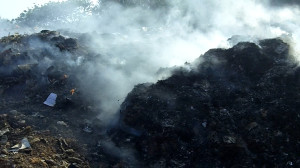
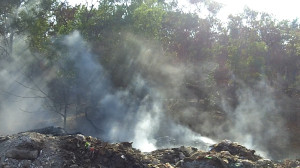
 For three consecutive years this dump has been set on fire to make way for more garbage. Every year the residents and school children suffer acute respiratory problems, eye infections and other health hazards because of the fire and smoke. While the MMC often blames it on the cashew farmers who clear fields by burning them, residents and activists feel it is being done on purpose. There are heaps and heaps of plastic smouldering from the very bottom of the pile. It is wet unsegregated waste and catches fire very easily. Some say that now only the monsoon rains will calm it down. The MMC must take responsibility for the rules it has violated.
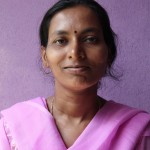
“I entered the site on a hot Sunday afternoon. The dump has one main gate that is monitored by security guards and another that is not really a gate but an opening in the fence and the shrubbery that borders the dump-yard. Earlier that day from my brother’s house in Mapusa, I had seen giant grey smoke clouds hover around the horizon and by the time I got there it had gotten worse. I walked further in towards the smoke, because I wanted to get a closer look at it, and I started feeling claustrophobic. At that time, I ignored it. I wasn’t scared of the security guards I could see lurking around at a distance, it was a pure adrenaline rush that I was functioning on; I was going to get this video made. When it got unbearable and my head started pounding, I finally decided that I needed to get away”, explains Sulochana.
For three consecutive years this dump has been set on fire to make way for more garbage. Every year the residents and school children suffer acute respiratory problems, eye infections and other health hazards because of the fire and smoke. While the MMC often blames it on the cashew farmers who clear fields by burning them, residents and activists feel it is being done on purpose. There are heaps and heaps of plastic smouldering from the very bottom of the pile. It is wet unsegregated waste and catches fire very easily. Some say that now only the monsoon rains will calm it down. The MMC must take responsibility for the rules it has violated.
“I entered the site on a hot Sunday afternoon. The dump has one main gate that is monitored by security guards and another that is not really a gate but an opening in the fence and the shrubbery that borders the dump-yard. Earlier that day from my brother’s house in Mapusa, I had seen giant grey smoke clouds hover around the horizon and by the time I got there it had gotten worse. I walked further in towards the smoke, because I wanted to get a closer look at it, and I started feeling claustrophobic. At that time, I ignored it. I wasn’t scared of the security guards I could see lurking around at a distance, it was a pure adrenaline rush that I was functioning on; I was going to get this video made. When it got unbearable and my head started pounding, I finally decided that I needed to get away”, explains Sulochana.
For Sulochana being a Community Correspondent comes with its own unique set of problems. The first is that many of her family members think that she shouldn’t be putting herself in these awkward situations to begin with.
“I was standing on the side of the road filming my piece to camera and my uncle drove by. I got caught red handed so I lied a little and told him about how my friend was making a film about my work as a Correspondent. Thankfully, he didn’t ask me to get on his bike and go home that very instant”, she giggles to cover up the importance of her victory. The second challenge that she faces, is community support. Sulochana has worked very closely with Goa's Saligao community so far; this story was her first venture to a different part of Goa. While many from the Assagao and Mapusa community were very forthcoming in their support others just stood by watching. Sulochana says: [caption id="attachment_10679" align="alignleft" width="300"]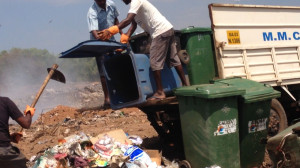 MMC truck dumping garbage.[/caption]
“Since the beginning of my involvement in this issue my main goal has been to mobilise the community. I found that there are a lot of small groups who are working to highlight this issue to the MMC and to the GSPCB. The problem is that they are not working together. The most disappointing thing for me as a native Goan is that more people are not taking on this responsibility. A lot of those who are organising meetings, roadside clean ups, efforts to meet officials are not native Goans, they have settled here from other places. Not that this makes much difference but what I find myself wondering is this—what would it take for more Goans to wake up and take control of this situation? What will it take for that sense of ownership to set in? Because after all, each one of us is equally responsible for generating waste.”
In the past three months, the fire has really helped galvanise action from various fronts of the community. Community members have been able to get the GSPCB to inspect the site and issue a fresh warning to the MMC. The community has taken to the streets organising demonstrations during the Goan Carnival and is channelling the more useful aspects of social media to keep solution-oriented discussions alive.
Sulochana hopes that once more people from the worst affected residential areas like Ganeshpuri, Ektanagar and Lakshminagar see the video she has made, during community screenings she has planned, they too will start coming forward. She realises that at the Assagao-Mapusa dump all people can really hope for is that the fire is put out immediately and for the MMC to start shifting this dumpsite to the proposed alternate site where there is a proper lining.
MMC truck dumping garbage.[/caption]
“Since the beginning of my involvement in this issue my main goal has been to mobilise the community. I found that there are a lot of small groups who are working to highlight this issue to the MMC and to the GSPCB. The problem is that they are not working together. The most disappointing thing for me as a native Goan is that more people are not taking on this responsibility. A lot of those who are organising meetings, roadside clean ups, efforts to meet officials are not native Goans, they have settled here from other places. Not that this makes much difference but what I find myself wondering is this—what would it take for more Goans to wake up and take control of this situation? What will it take for that sense of ownership to set in? Because after all, each one of us is equally responsible for generating waste.”
In the past three months, the fire has really helped galvanise action from various fronts of the community. Community members have been able to get the GSPCB to inspect the site and issue a fresh warning to the MMC. The community has taken to the streets organising demonstrations during the Goan Carnival and is channelling the more useful aspects of social media to keep solution-oriented discussions alive.
Sulochana hopes that once more people from the worst affected residential areas like Ganeshpuri, Ektanagar and Lakshminagar see the video she has made, during community screenings she has planned, they too will start coming forward. She realises that at the Assagao-Mapusa dump all people can really hope for is that the fire is put out immediately and for the MMC to start shifting this dumpsite to the proposed alternate site where there is a proper lining.
 But what then? We’d have just won a single victory against the irresponsible MMC. Goa’s garbage problems aren’t going to disappear overnight, to really start to deal with this issue we need a multi-dimensional strategy. A large part of the solution is segregation at source. Community media can play a crucial role in this mobilisation. Sulochana echoes this thought:
“I can’t make these small videos about different garbage issues across Goa and leave it. We have to acknowledge that there are a lot of communities doing some great things when it comes to creating awareness on garbage issues. These positive stories are what need to be shown to every single citizen to make us all realise that it is possible.
I have made some videos on such recycling and segregation initiatives and now I am trying to get these screened in schools and pair them up with live demonstrations and workshops for kids. If it becomes part of the curriculum all the better, but I wont hold my breath on that because our present Chief Minister doesn’t quite get these concepts. Left to him he’d set up a huge garbage treatment plant that takes in unsegregated garbage. I’m not sure what will happen to the 20,000 tonnes of waste in Mapusa. There are many people working to solve that. My main contribution as a Community Correspondent can be to intervene and become part of a process that changes mind sets. That is my strength and I will make it my Goan community’s strength as well.”
But what then? We’d have just won a single victory against the irresponsible MMC. Goa’s garbage problems aren’t going to disappear overnight, to really start to deal with this issue we need a multi-dimensional strategy. A large part of the solution is segregation at source. Community media can play a crucial role in this mobilisation. Sulochana echoes this thought:
“I can’t make these small videos about different garbage issues across Goa and leave it. We have to acknowledge that there are a lot of communities doing some great things when it comes to creating awareness on garbage issues. These positive stories are what need to be shown to every single citizen to make us all realise that it is possible.
I have made some videos on such recycling and segregation initiatives and now I am trying to get these screened in schools and pair them up with live demonstrations and workshops for kids. If it becomes part of the curriculum all the better, but I wont hold my breath on that because our present Chief Minister doesn’t quite get these concepts. Left to him he’d set up a huge garbage treatment plant that takes in unsegregated garbage. I’m not sure what will happen to the 20,000 tonnes of waste in Mapusa. There are many people working to solve that. My main contribution as a Community Correspondent can be to intervene and become part of a process that changes mind sets. That is my strength and I will make it my Goan community’s strength as well.”
We urge the District Collector to ensure that the fires at the landfill are doused and dealt with as per the Management of Solid Waste Rules immediately. We want permanent systems to be put in place so that this does not occur again.
You can sign the petition on change.org to support the residents of Goa.
Fighting for Change: The Story of Bihar-Based Journalist Amir Abbas
Inspiration can come from many sources, but one of the most powerful is seeing someone walk the path before you. Our Community Correspondent, Syed Amir Abbas found his inspiration in Stalin K., the founding director of Video Volunteers. “I met Stalin at VV’s national meet in 2017 and I...
The torch bearer of rights for marginalized tribals of Odisha
If you ask Video Volunteers’ Community Correspondent Bideshini Patel to rate her childhood on a scale of 1-10, she would probably give it a negative marking due to the neglect and abuse she faced. But if you ask her to evaluate her professional life as an impactful journalist, resolving basic...